From a folder of CVs to a shortlist you can defend
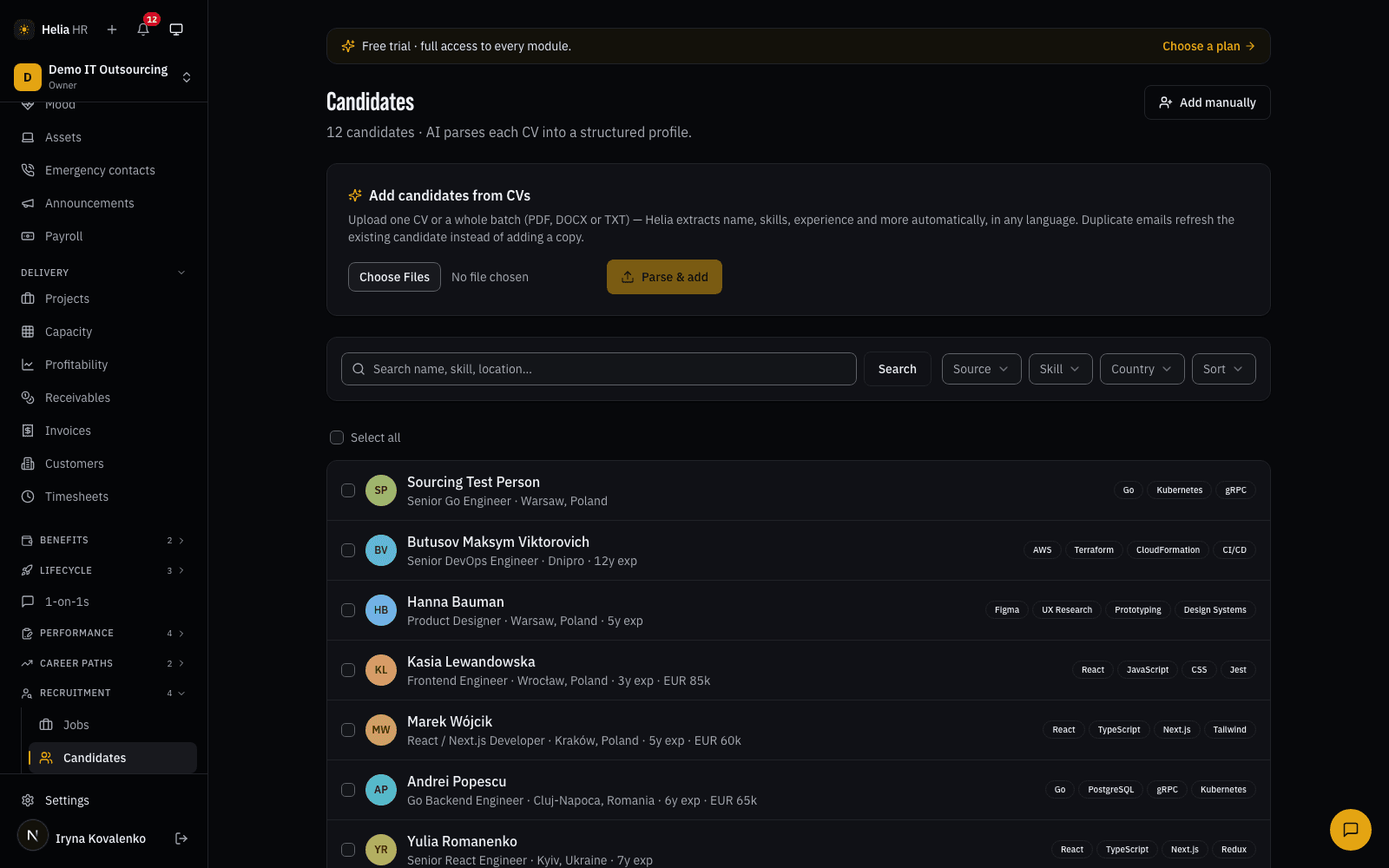
One opening draws a few hundred applications, and most of them arrive as a PDF attached to an email. Helia takes the folder: upload a single CV or a batch of up to twenty-five — PDF, DOCX or TXT — and each one comes back as a structured profile with name, contacts, current title, location, years of experience and extracted skills, in whatever language it was written in.
Two details save the most time:
- A repeat email updates the person, not the list. Someone who applied in spring and again in autumn stays one candidate with two applications, rather than two half-filled records nobody reconciles.
- Screening scores against that role's own requirements and writes down what matched and what didn't. It ranks and explains; the recruiter decides. Nothing is rejected automatically and nothing changes stage on its own.
Skills, source, country and free text stay filterable afterwards, so the database you build while hiring for one role is still worth something when the next one opens.
One pipeline everybody reads the same way
Applications move Applied → Screening → Interview → Offer → Hired, with Rejected as the honest terminal state. Rename the stages to the words your team already uses; the board underneath does not care.
Each interview gets a scorecard instead of a hallway impression — its criteria pre-seeded from that role's own requirements — so a decision made two weeks later rests on what people wrote at the time. Instead of a scheduling thread, propose up to eight slots and give the candidate a link where they pick one. The offer is composed from its own terms, emailed to the candidate, and accepted or declined on a link that needs no account.
Recruiting analytics reads those same records: open roles, candidates in pipeline, average time-to-hire, hires in the last 90 days, the stage-by-stage funnel with conversion, how long candidates sit in each stage, which sources actually produce hires, and why the ones who left left — company declined, candidate withdrew, or nobody wrote it down.
That last number is usually the uncomfortable one, and it is the one that shows where the process leaks.
A careers page, and an application that respects the applicant
Every workspace gets a public careers page under its own name: open roles, the description, and an apply form with CV upload. Publishing a role puts it there, closing it takes it down — no website ticket, no developer in the loop for a typo.
Applications arrive with consent recorded and a twelve-month retention horizon attached. A daily job actually enforces it: when the horizon passes, the CV file is deleted, the candidate archived, and the erasure written to the audit log. Candidates a recruiter adds by hand carry no automatic horizon — their consent came from somewhere Helia cannot see — so there is an explicit action to record it once you have it.
Look at your own bench before you post the role
The redeployment board is the part a standalone applicant-tracking tool structurally cannot do, because it never knows who is finishing a project. People whose assignment ends within the next 45 days are listed against your open roles, matched on overlapping skills and department, with the reason for the match shown rather than a score you are asked to trust.
Redeploying an engineer you already employ beats hiring one, and the moment to notice is before the ad goes out. This board reads assignment data, so it fills up for workspaces running the Delivery pack; the rest of Recruitment works without it.
How it fits with the rest of Helia
Recruitment sits on Helia Base, which holds the employees — which is why "hired" is not where the record stops. Hiring a candidate creates the employee: name, title, department, and the skills parsed off their CV as their tech stack. If you have an onboarding template for that department, their checklist is instantiated in the same action. If the role was opened to staff a specific project, the new hire is assigned to it.
Every AI step here — the job-description draft, the CV parsing, the screening — is a switch the owner controls in Settings → AI, per feature. Turn screening off and the pipeline still runs; you read the CVs yourself.
Recruitment is the one pack billed per company rather than per person, so the whole hiring committee can be in it. Pricing for every pack, with a calculator, is on the pricing page.