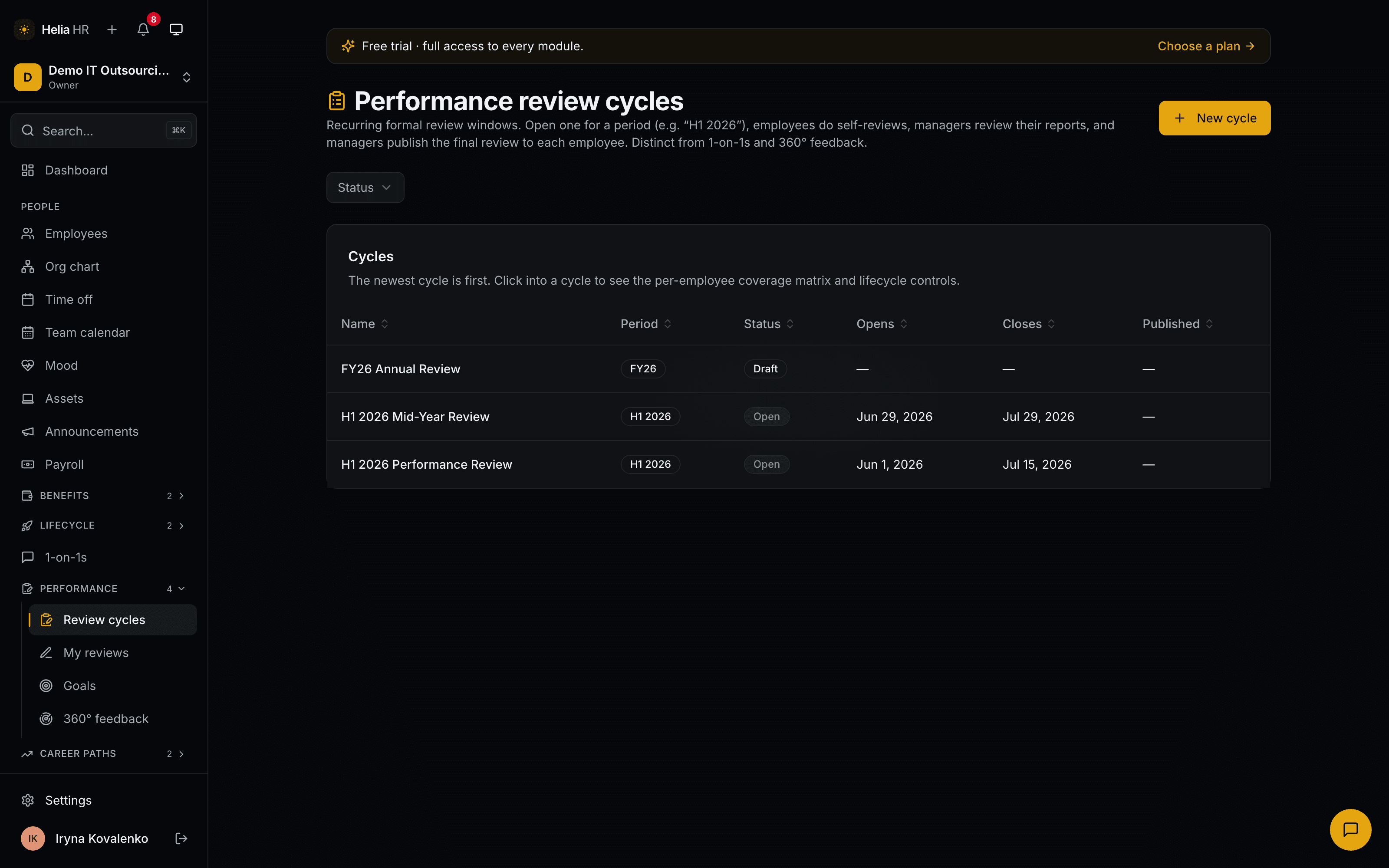
A cycle that can actually be finished
Creating a cycle takes a name, a period label in your own words, and whether you want self-reviews, manager reviews or both. Opening it is the step that does the work: every active employee hired before the open date gets a self-review row, everyone with a manager gets a manager-review row addressed to that manager, and each of them is notified in-app and by email.
That single decision removes the spreadsheet. Nobody maintains a list of who owes what, because the list is the cycle: a matrix of people down the side, Self and Manager across the top, each cell either empty, drafted, submitted with its rating, or published.
A closing date is a soft deadline on purpose — the cycle stops accepting work when you close it, not when a timestamp passes, because the last three reviews always land late and locking them out helps nobody. What the date does buy you is a nudge: anyone still holding an unsubmitted review gets reminded in the week before, and not again for three days.
The same four questions for everyone
Every response — self or manager — is the same shape: an overall rating from Below expectations to Outstanding, a summary, what went well, and where to grow. Not a configurable question bank, and that is the current trade: one shape means a manager's second review takes ten minutes instead of thirty, and two people in the same cycle can actually be compared.
What happens after submit is the part worth understanding, because it is where most review tools leak. A self-review becomes visible to its author on submit — you wrote it, you can read it. A manager's review goes to manager-only and stays there until the manager (or HR) explicitly publishes it to the employee, which sends them a notification with a link. There is no state in which an employee reads a half-written assessment of themselves, and no state in which HR silently publishes on a manager's behalf without it being their click.
HR can see every response in the cycle and can publish for a manager who has left or forgotten. Everyone else sees exactly their own.
Goals are objectives with key results, and the maths is visible
An objective is a sentence; a key result is a number that moves. Each key result carries a start value, a current value, a target and a direction, so progress is arithmetic rather than a status colour someone picked. The objective's own progress is the plain average of its key results — stated on the page, because a weighted average nobody can reproduce is how goal tools lose trust — and lands in an on-track, at-risk or off-track band.
Goals align to each other: pick a parent within the same period and a tree view shows the whole cascade, with a parent that has no key results of its own displaying the average of the goals contributing to it. HR can set goals for anyone; a manager can update goals for people in their chain; everyone else can set and update their own. Every goal in the workspace is readable by everyone in it — deliberately, because goals nobody can see coordinate nothing.
Progress updates are manual and carry a short note: the last one is kept beside the number, which is what a reader needs when a key result has not moved in three weeks.
360° feedback that protects the people who answered
A manager launches a round for someone in their own chain, HR for anyone. The reviewers are the person themselves, their manager, and the peers whoever launched it nominates. Everyone answers on the same five competencies — delivery and quality, collaboration, ownership, communication, growth mindset — on a five-point scale, plus two questions: what should they keep doing, and one thing to improve.
The anonymity model is specific, and worth stating precisely rather than reassuringly. Self and manager answers are labelled as such — with one manager, that is effectively attributed, and pretending otherwise would be dishonest. Peer answers are pooled: nothing is shown at all until at least the minimum number of peers has responded, and then only as an average plus comments labelled by relationship, never by name. Below the threshold, nobody sees the peer data — including HR.
Results stay with the requester and HR until someone explicitly shares them with the subject. The page marks a hidden strength where others rate meaningfully above the self-rating, and a blind spot where they rate below.
How it fits with the rest of Helia
A manager staring at a blank review form can ask for a draft. It reads their own rough notes, the employee's submitted self-review, their goals and key results, and the pooled 360° averages — never an individual peer comment, and never anything about pay — and fills the form in, editable, in the manager's language. It saves nothing: if the manager does not press save, the draft never existed. The owner can switch it off entirely in Settings → AI.
Reviews & Goals deliberately stops where Career paths begins. Grade ladders, the criteria published against each grade, promotion readiness and grade history are that pack, not this one — a review tells you how the last six months went, a ladder tells you what the next grade requires, and conflating them is how performance reviews turn into promotion arguments.
The pack sits on Helia Base, which supplies the people and the reporting lines the cycles are generated from, and is metered per employee, per month. Pricing for every pack, with a calculator, is on the pricing page.