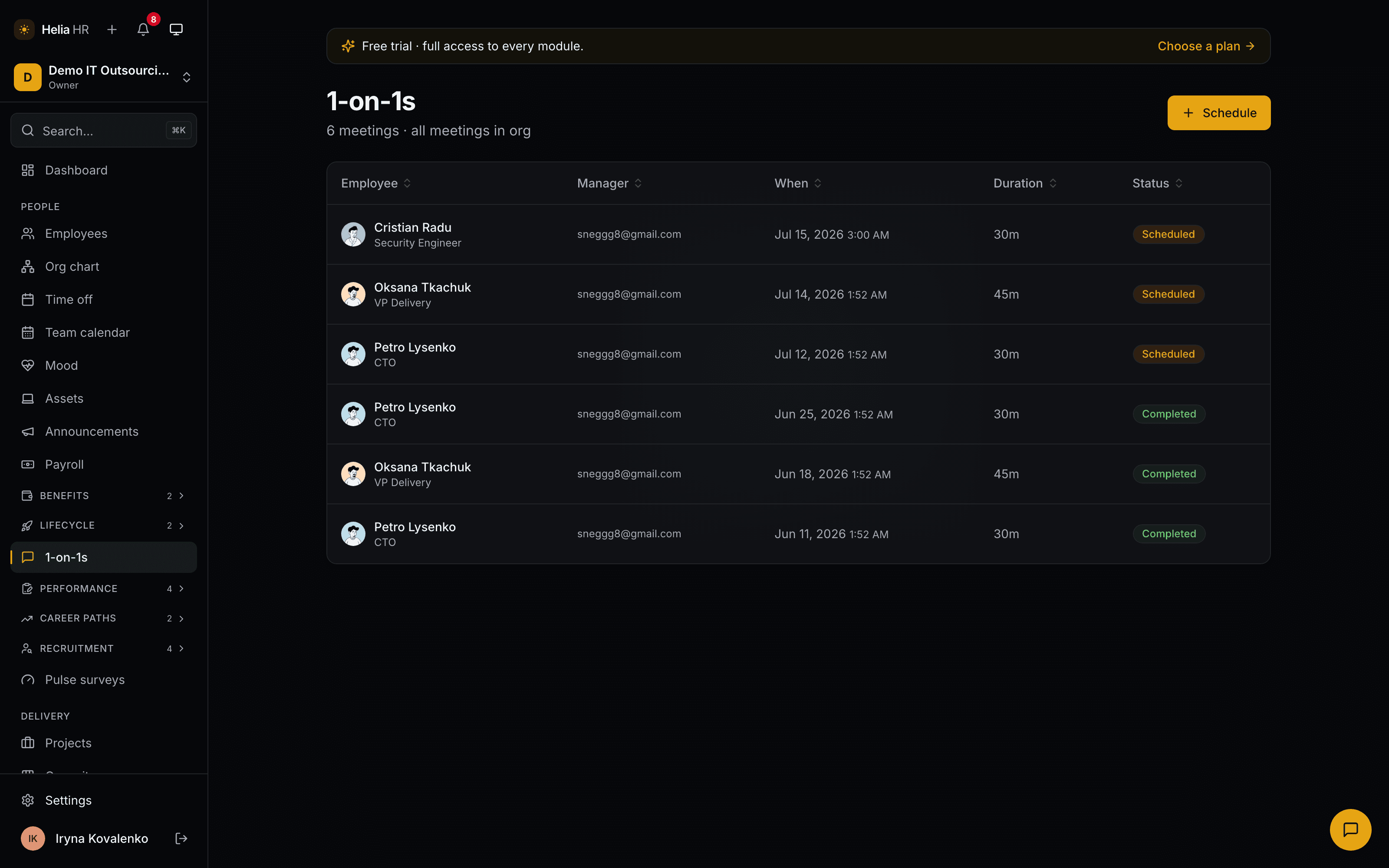
The meeting that quietly stops happening
Nobody cancels 1-on-1s on purpose. They lapse: a sprint runs long, the recurring invite gets declined once, and three months later a manager cannot remember what their engineer is worried about.
A meeting in Helia carries a cadence in weeks — weekly, fortnightly, roughly monthly, anything up to a year. When the manager marks today's conversation done, the next one is created on that rhythm. If they forget to mark it done, a nightly job rolls the series forward anyway, so the schedule survives an ordinary bad week. "Stop repeating" clears the cadence and the series ends where you meant it to.
An agenda, not a blank page
Nine built-in agendas cover the conversations a services team actually has: the first 1-on-1 with a new report, the standard weekly, a monthly deep-dive, a career conversation, a skip-level, a return from parental or long leave, a 90-day check-in, a project kickoff, and a performance turnaround. Pick one and edit it freely — they are starting points, not a form to complete.
Items written as checkboxes do something extra. Anything still unticked when the meeting ends can be carried into the next agenda in one click, with a count so you know what you are picking up. That is the difference between a note-taking habit and a follow-through habit.
What "private" means here, exactly
Every note is either shared or private, chosen when you write it.
A private note is readable by its author and by nobody else. Not the employee, not another manager, not the HR manager, not the owner of the workspace. This is enforced by a row-level security policy on the notes table with FORCE ROW LEVEL SECURITY — the database itself refuses the read, so it holds regardless of which screen or export asks.
A shared note is visible to both people in the meeting and to the HR chain, which is what makes it the right place for agreed actions and decisions.
The distinction matters because a manager who suspects their notes are readable writes useless notes. "Worried about burning out on the client project" only ever gets written down in a system where writing it down is safe.
And what HR can see
Being precise about the other half of that promise is the point.
The HR chain — owner, admin and HR manager — can see that a meeting exists, who it was between, when it happened, how long it ran and whether it was completed, cancelled or missed. They can read shared agendas and shared notes. They cannot read private notes.
That boundary is deliberately useful. An HR manager can answer "is every team lead actually running 1-on-1s?" from the meeting list without reading a word of what was said. Everyone else — a colleague who is not a participant — gets nothing at all: the module returns a 404 rather than an empty page.
One consequence worth knowing before you buy: because visibility follows the manager recorded on each meeting, a reorganisation does not hand a new manager the previous manager's history. The employee keeps their own record; the notes do not transfer.
How it fits with the rest of Helia
1-on-1s sit on top of Helia Base, which holds the people, the reporting lines and the permissions this module reads. It is priced per employee, like the rest of the HR core, and it is one of the five packs that collapse to the bundle rate when you run them together.
There is no AI in this module, and that is a choice rather than a gap. A summarizer that reads what was said in a private conversation would undo the guarantee the rest of the page is built on.
Pricing for every pack, with a calculator, is on the pricing page.