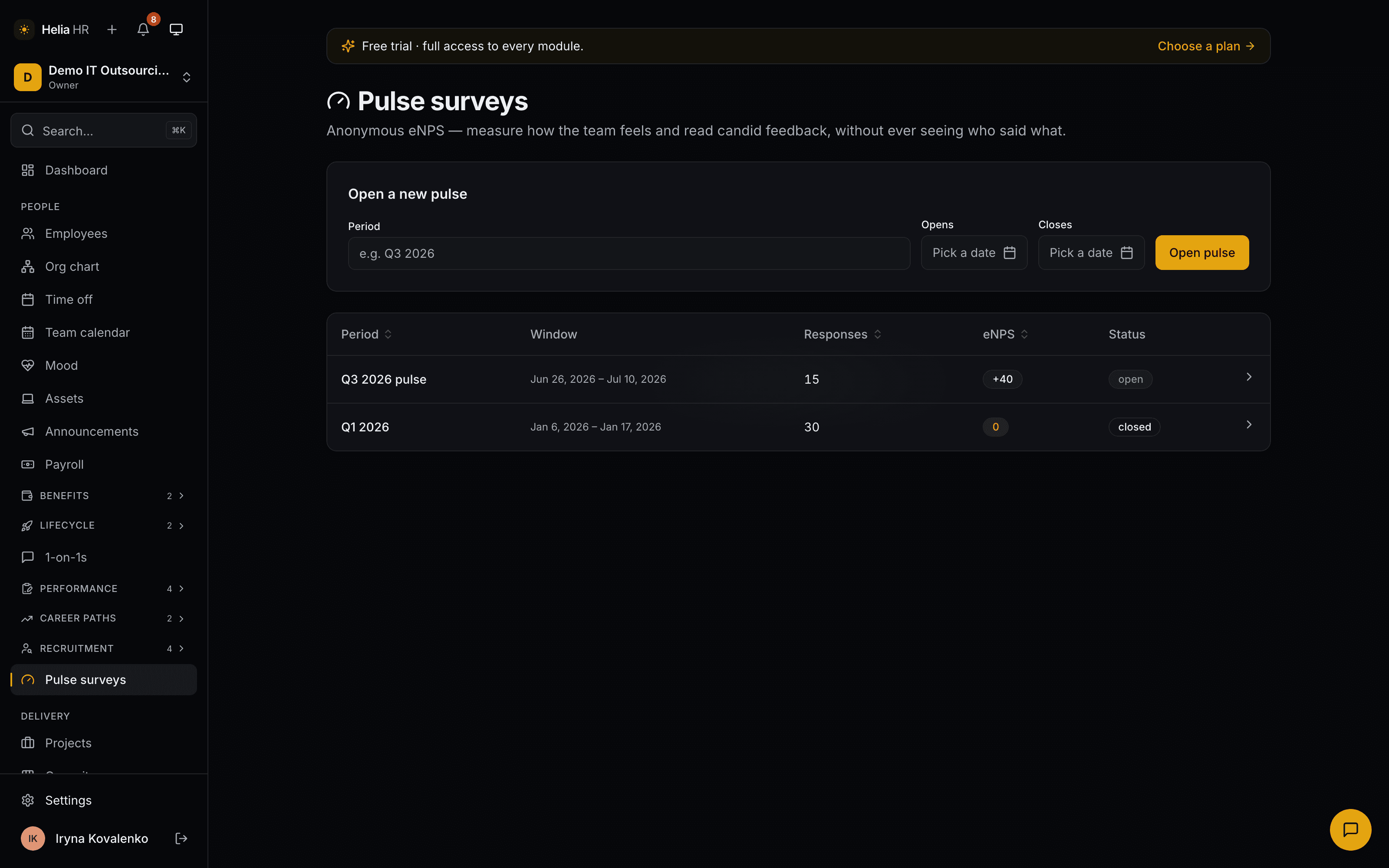
One question, answered honestly
A pulse cycle is a labelled period with a start and end date — "Q3 2026", two weeks — and one question: how likely are you to recommend this company as a place to work, from 0 to 10. A comment is optional, and optional is the point: people who have something specific to say will write it, and forcing everyone else to produce a sentence just fills the set with noise.
Everyone on staff answers from the same page they use for everything else. Scores of 9 and 10 count as promoters, 7 and 8 as passives, 0 to 6 as detractors, and eNPS is the promoter share minus the detractor share — the standard calculation, so your number is comparable to anything you have measured before.
Once answers start arriving the cycle's label and dates lock. A survey whose window shifted underneath already-collected responses is a survey you cannot defend, so Helia refuses the edit and offers you a fresh cycle instead.
How the anonymity actually works
Most tools say "anonymous" and ask you to trust the interface. Here is the mechanism instead, because you should be able to check it.
Two tables. The answer row holds the score, the comment and a coarse department tag. It holds no employee id and no foreign key pointing at anything that does. The token row holds a SHA-256 hash of the cycle and the employee, mixed with a server-side secret, and nothing else — no score, no text.
When you submit, the token is written first. If a row already exists for your hash the insert is refused and you are told you have already responded. Only then is the answer written, into the other table, unlinked. Reversing the hash to an employee is not possible without the server secret, and even with it the hash points at a person, never at what they said.
That is why the response rate and the eNPS can both be honest at the same time: the count comes from the tokens, the score comes from the answers, and nothing joins them.
The floor that makes small teams safe
Anonymity by schema is not enough in a fifteen-person company. If two people answer and one leaves a pointed comment, arithmetic does the de-anonymising that the database refused to do.
So results are withheld below three responses. The eNPS, the distribution across 0–10 and the comments themselves are all suppressed until the fourth person replies; the bare response count still shows, because a count on its own reveals nothing. The AI theme pass has a higher bar again and refuses to run under five comments.
Three is a deliberate choice for teams of five to fifteen rather than a number copied from an enterprise tool. Set it higher and a small company's every cycle comes back blank, which teaches people that answering is pointless.
Reading thirty comments in a minute
Scores tell you the temperature. Comments tell you why, and they are the part nobody has time for — thirty free-text answers is an hour of careful reading that quietly never happens.
Helia AI clusters them into three to six themes, each with a label, a sentiment, how many comments mention it and a short summary, plus an overall read and a few suggested actions. The result is saved on the cycle, so it is generated once rather than every time someone opens the page.
The model is instructed to work in aggregate only: never quote a comment word for word, never name or infer an individual, never single out a team of one. And the whole feature is optional — switch AI off in Settings and the pulse, the eNPS, the trend and the raw comments all keep working exactly as before.
How it fits with the rest of Helia
Engagement sits on top of Helia Base, which holds the people the response rate is measured against. Only the HR chain — owner, admin and HR manager — opens and reads a cycle; everyone else sees the page as a question to answer.
It is a distinct thing from the daily mood check-in in Helia Base, and worth not confusing: mood is attributed on purpose, so an HR partner can follow up with a person having a bad month. The pulse is anonymous on purpose, so the company can hear what nobody wants to sign. Running both is reasonable; running one and calling it the other is not.
Engagement is priced per employee and billed separately from the five-pack core bundle. Pricing for every pack, with a calculator, is on the pricing page.