Who is on what — this week and in twelve
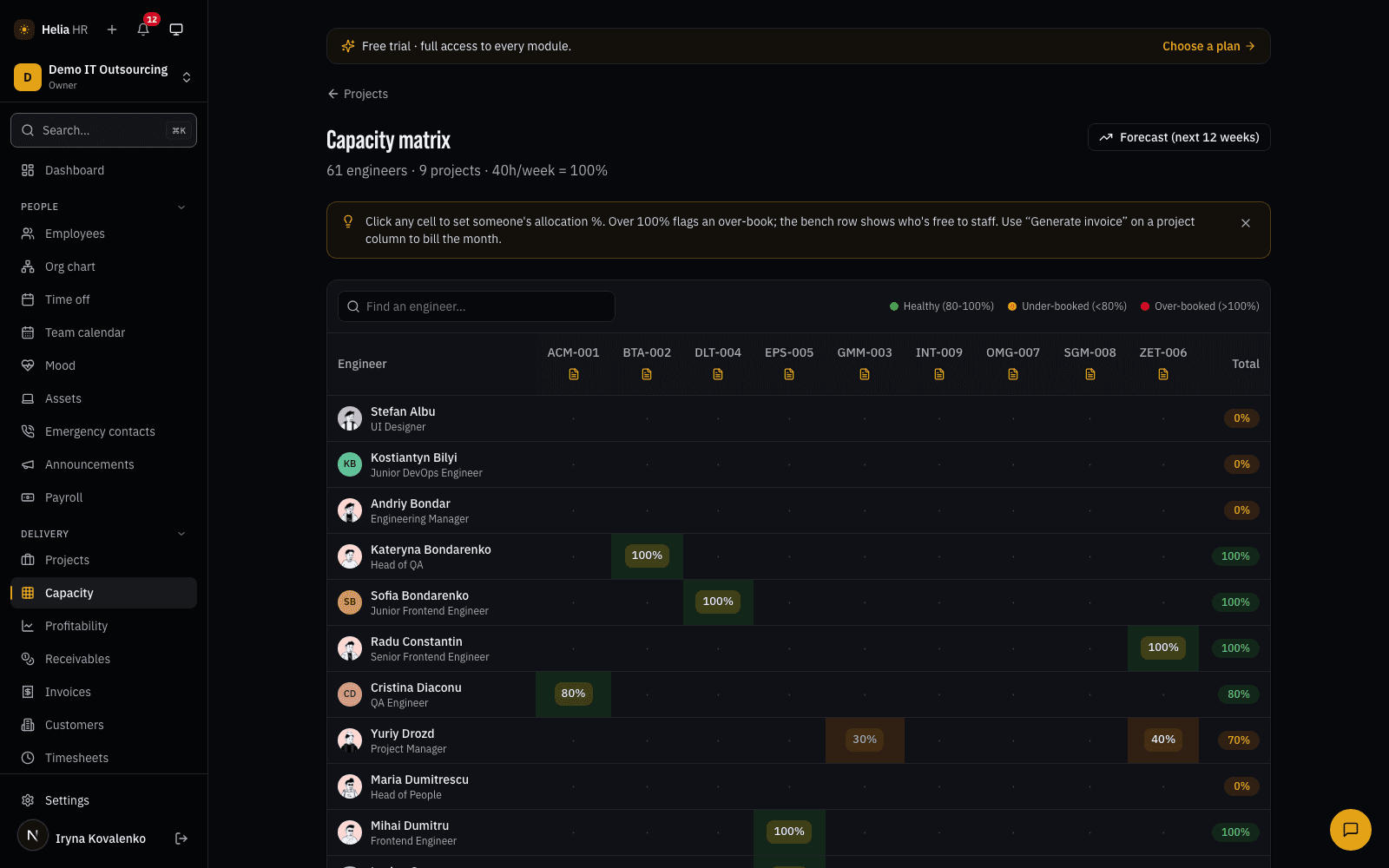
The capacity matrix is people down the side, weeks across the top, and an editable percentage in every cell. Change an allocation and the row total, the utilization figure and the forecast move with it — no recalculation step, no second spreadsheet that disagrees.
Three things make it usable rather than decorative:
- Approved time off is already subtracted. A plan that counts someone as available while they are on vacation overbooks exactly when it hurts most.
- The bench is a row, not an inference. Anyone under 100% shows up in it, with the hours they have free.
- Over-booking is flagged. Somebody at 130% across three projects is a delivery risk wearing the costume of excellent utilization.
The forecast runs twelve weeks: long enough that roll-offs are visible while there is still time to sell or redeploy, short enough that the numbers stay honest.
Timesheets a manager will actually approve
Hours are logged against a project and an assignment, reviewed by the delivery manager, and locked once approved. Approval is the point of the whole exercise: an unapproved hour never reaches an invoice, so a client dispute is about scope rather than about whether the number was ever checked.
Engineers who would rather not type hours twice don't have to. Connect Jira and logged work arrives as draft entries a manager reviews — the timesheet becomes a byproduct of the work instead of a Friday-afternoon chore.
From approved hours to a sent invoice
Billing a month is one pass, not a project. Pick the customer and the period, and the invoice is built from approved billable hours at the rates on each assignment — with VAT, a due date and a sequential invoice number.
From there it is a PDF, a CSV for the accountant, or an email to the client with a tokenized link they can open without an account. Sent, paid and overdue are tracked on the receivables view, and an overdue invoice carries a reason so "why is this late" has an answer that isn't someone's memory.
Profitability without an export
Revenue against fully-loaded cost, per project and per customer, consolidated across the currencies you invoice in. Together with utilization, it answers the two questions a services business runs on: is the team busy, and is the work worth doing.
The point is that these are the same records. The allocation the delivery manager edited, the hour the engineer logged, the invoice the client received and the margin on the report are one chain — not four systems reconciled by hand at month-end.
How it fits with the rest of Helia
Delivery sits on top of Helia Base, which carries the people themselves — the directory, the org chart, time off and the audit log. That is why time off can reduce capacity automatically: it is the same employee record, not an import.
Delivery is metered per billable user — employees whose time you sell — rather than per employee, so the overhead half of the company does not inflate the bill. It follows your workspace type: switch the organization to services and the whole cluster appears in the sidebar; switch to product and it steps out of the way.
Pricing for every pack, with a calculator, is on the pricing page.