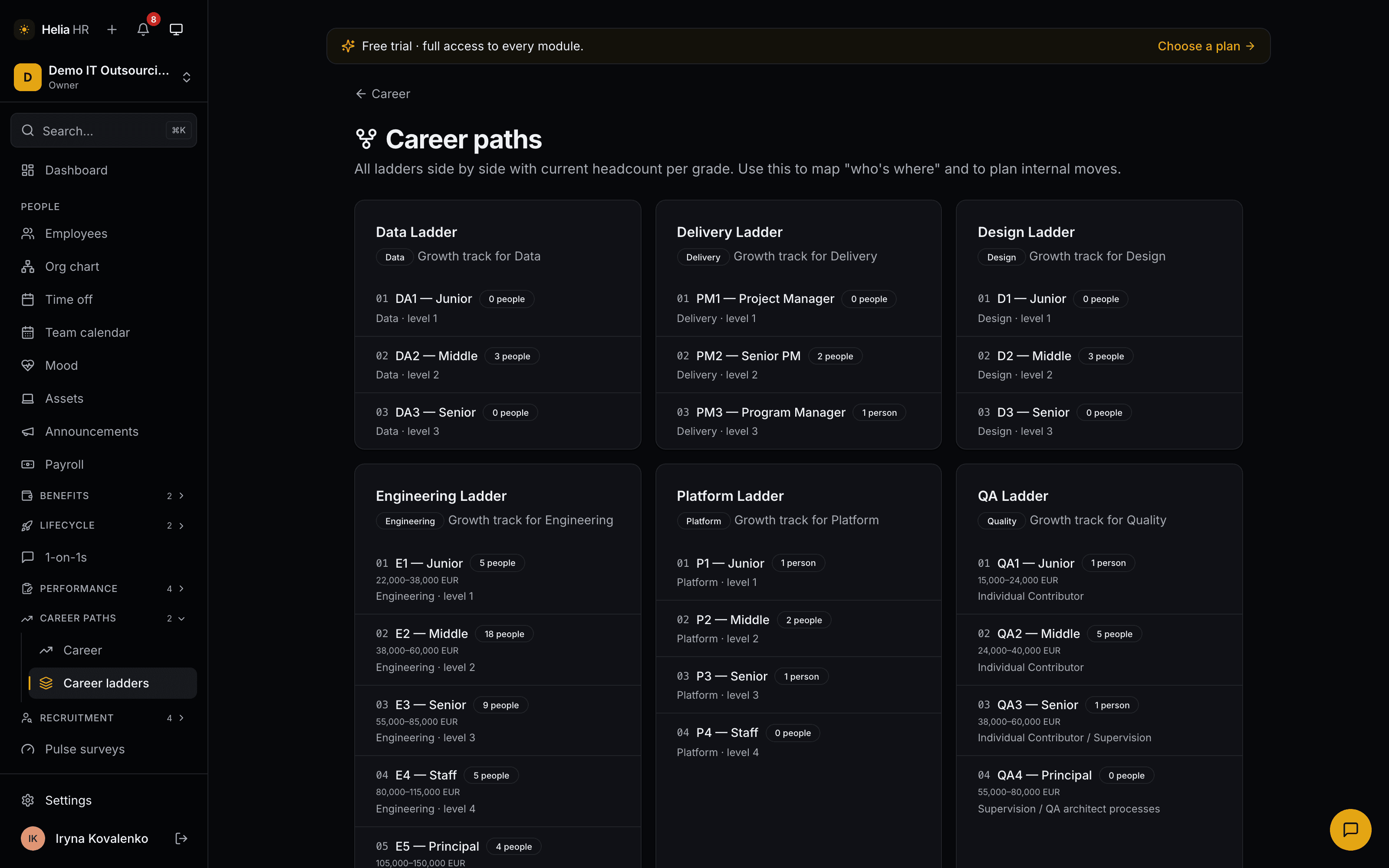
The ladder, written down once
A ladder belongs to a department and holds as many grades as that discipline needs — five for engineering, four for QA, three for design. Each grade has a position, a name your team already uses, its own list of criteria, and optionally a salary band.
HR writes the criteria as plain lines of text, one per line, because that is what they are: a description of the work expected at that level. Helia does not ask you to score them, weight them or tick them off. A ladder is a published standard, and pretending it is a measurable checklist is how competency frameworks become theatre.
Everyone in the company can read every ladder. That is deliberate: a grade rubric only changes behaviour if the people it applies to can see it without asking their manager for a copy.
Who is where, across every track
One view puts all your ladders side by side with a live headcount on each grade — five at E1, eighteen at E2, nine at E3. It is the fastest read available on the shape of your organisation: a bulge at middle grade with nothing above it is a retention problem you can see before it becomes three resignations.
Salary bands sit on the grades that have them, and they follow the salary-viewing permission rather than a job title — someone without it sees the ladder and the criteria, and no numbers at all.
For companies preparing for the EU Pay Transparency Directive, this is the part that matters: the directive expects you to be able to describe the criteria used for pay and progression, and a published ladder with bands is most of that answer already.
Promotion as a request, not a corridor conversation
An employee opens their ladder, sees the grade above, and files a request for it with a written case. The HR chain gets a notification; the request appears in a queue.
Approving it writes a dated row into that person's grade history and tells them. Rejecting it requires a reason — a rejection with no explanation is the single most corrosive thing a career framework can produce, so the product will not let you send one. The employee can withdraw a request they no longer want to pursue, and only one open request per target grade is allowed, so the queue cannot be gamed by volume.
What accumulates is a history: which grade, effective from when, decided by whom. The employee sees their own progression; HR sees it per person and in aggregate.
A readiness shortlist, and what it is not
HR gets a ranked list of who might be ready, scored out of 100 from three inputs it names openly:
- Time in the current grade — up to 40 points, full marks at a year.
- Position within the salary band — up to 30 points, full marks in the top quarter.
- The last manager review rating — up to 30 points.
Above 70 reads as ready, above 40 as building, below that as too early. When all three inputs are missing the score is unknown rather than a number — the model refuses to invent a figure it cannot support.
Three things this is not. It is not automatic: a human still files and approves every promotion. It is not visible to the employee — the score exists on the HR view only, and a heuristic shown to the person it ranks would be read as a promise. And it is not a substitute for judgement; it is a way of making sure the quiet senior who never asks does not get overlooked for the third cycle running.
How it fits with the rest of Helia
Career paths sits on Helia Base, which holds the people, departments and permissions it reads. It is priced per employee and is one of the five packs that collapse to the bundle rate together.
It composes with Reviews & Goals rather than depending on it: the readiness score uses the last manager review rating for 30 of its 100 points, and the AI growth plan reads current goals and 360° feedback when they exist. Without the performance pack the module still works — the score simply leans on the two inputs it has.
The AI growth plan drafts against the gap between someone's current grade and the next, and against their goals. Feedback is only included once enough people have responded to keep it unattributable, and the draft is edited and saved by a human before it exists as a plan.
Pricing for every pack, with a calculator, is on the pricing page.